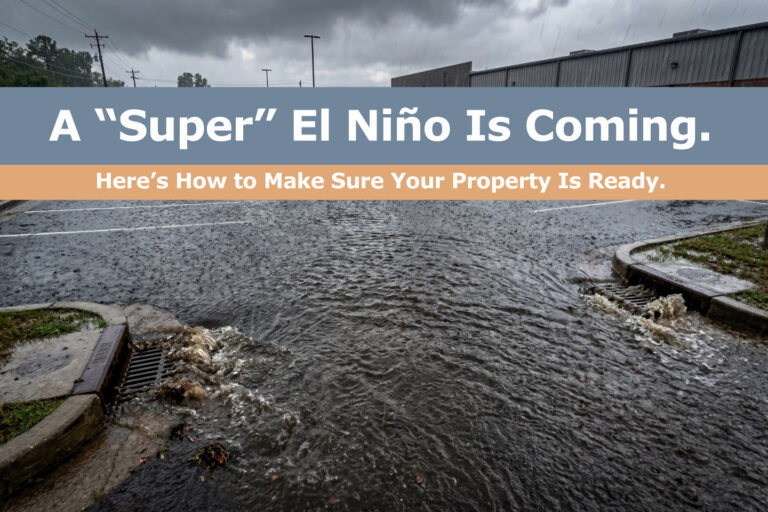
NOAA is now putting the odds at greater than 80% for a very strong El Niño this fall and winter — with some forecasters giving it a real shot at becoming one of the strongest on record. For California property owners, facility managers, and contractors, that’s useful information: it’s a good year to get ahead of storm season rather than react to it as it happens.
Strong El Niño winters have a track record here. The 1997–98 season more than doubled Southern California’s average annual rainfall, and 1982–83 was even wetter. Eight of the last ten
moderate-to-strong El Niño winters brought above-average precipitation to the region. Worth noting: the 2015–16 El Niño was just as strong by ocean-temperature measures and still turned out drier than expected, so a strong forecast doesn’t guarantee a wet winter. But it’s a good enough reason to spend a little time this month making sure your site is set up to handle more rain than usual, rather than finding out mid-storm.
What a Wetter Winter Means for Your Site
More storms simply put more demand on a property’s drainage system. Storm drains, culverts, and detention systems that handle a typical year just fine can get stretched when several storms stack up back-to-back. Ground that’s already saturated from one storm has less capacity to absorb the next. And for sites near a recent burn scar, stripped hillsides can send a lot more runoff downhill than the surrounding drainage was originally designed for.
For most commercial and industrial property owners, the systems doing the real work here are the permanent, post-construction BMPs required under your property’s Water Quality Management Plan — bioswales, detention and infiltration basins, trash capture devices, and similar structural controls. Those systems are built to handle a normal year with routine upkeep. A season with several strong storms in a row is exactly when a summer’s worth of sediment, debris, and vegetation overgrowth catches up with them, right when you need them working at full capacity.
None of this is unusual or alarming — it’s just what a bigger winter asks of the systems already in place. The properties that come through it smoothly tend to be the ones that took a look at their WQMP BMPs in August or September, while there’s still time to clean out or repair anything that needs it, rather than in the middle of the first big storm.
What “Ready” Looks Like
A little groundwork now goes a long way:
- WQMP-required BMPs — bioswales, basins, trash capture devices, and similar structural controls — inspected, cleaned out, and repaired ahead of the season, not just checked off once a year
- Clear ownership of monitoring and inspection tasks, so nothing falls through the cracks when storms come frequently
- An actual plan for who responds if a storm hits after hours or on a weekend
That’s the work we do every day at California Compliance Environmental. Our team handles WQMP BMP maintenance, SWPPP development, inspections and monitoring, and rapid field response when storms roll in — for commercial and industrial property owners, multi-site portfolios, and construction projects across Northern and Southern California.
If it’s been a while since anyone took a close look at your stormwater setup, this is a good month to do it. We offer no-cost site evaluations to see where things stand, plus free competitive bids so you know exactly what it would take to be ready — no obligation, no pressure.
Northern California: (510) 775-8005
Southern California: (949) 299-7533
Email: sales@cacompenv.com