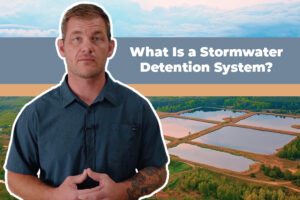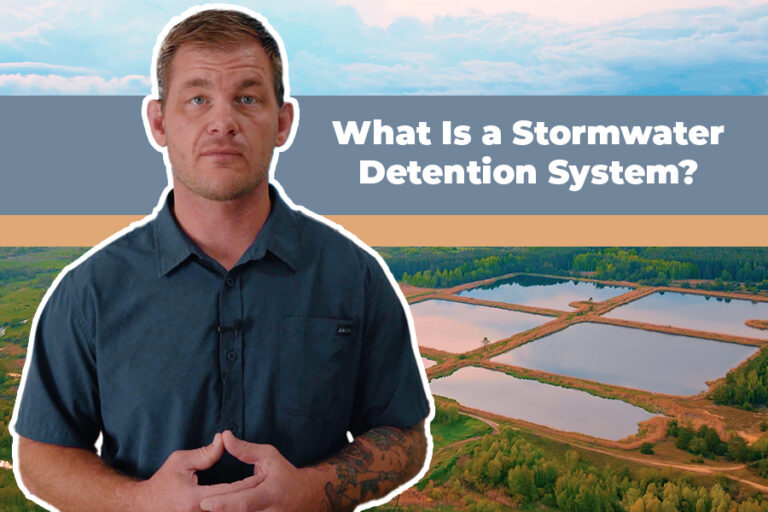
In our latest video, Joe Warner from California and Texas Compliance Environmental breaks down the basics of these essential systems. At its simplest, a detention system is designed to temporarily hold stormwater and release it slowly. This process is vital for several reasons:
- Infrastructure Protection: Local cities and counties often cannot handle a massive, sudden volume of water. These systems slow the flow, giving municipalities more control over the water entering their infrastructure.
- Water Quality: Detention systems provide filtration, leading to better water quality upon discharge.
- Safety and Health: Unlike “retention” systems that stay wet, detention systems are designed to be dry within 72 hours of a rain event to prevent them from becoming mosquito breeding grounds.
The video also explores the different configurations you might see, from large above-ground “dry ponds” that can span several acres to hidden underground chambers made of big corrugated pipes.
Whether you have an obvious open pond or are unsure if your site has an underground system, understanding your stormwater obligations is key to staying compliant. Watch the video to learn more, and if you need an expert to inspect your site or provide a quote for monitoring and maintenance, reach out to our team today.
Video Transcript
0:00 Intro
0:04 What IS a Detention System?
0:15 Detention System Configurations
0:55 Retention Systems
0:00 Intro
Joe Warner with California Compliance Environmental and Texas Compliance Environmental.
0:04 What IS a Detention System?
Customers are asking, ‘What is a detention system?’ A stormwater detention system. And really, all a stormwater detention system is, is something that’s going to temporarily hold on to water and then slowly release it.
0:15 Detention System Configurations
So, you’re going to have different configurations of a stormwater detention system. You can have underground chambers—big corrugated pipes underground—that are going to hold on to stormwater and slowly let it infiltrate back into the earth, or put a smaller orifice on it to allow that water to escape slowly.
Then you also have above-ground detention systems, and those are going to take up a lot more space. They might be, you know, half-acre, you know, a few acres, depending on how much surface runoff is going into those detention systems. That’s going to be an open dry pond. Those detention systems are meant to be dry after a rain event. You usually want the water out of there within 72 hours to prevent any kind of mosquito breeding center.
0:55 Retention Systems
You have retention systems, which are actually going to hold on to water and stay wet. And you have detention systems that are made to slowly release the water. A part of that is you’re going to get some filtration out of those detention systems. You’re going to get better water quality on the other side of that when it is discharged. And the other part of that is the counties and the cities that have their infrastructure to worry about. They’re not prepared for that much volume of water during a rain event. So they’re trying to slow that water down to have a little bit more control over how much water is entering their infrastructure as well.
So if you have any more questions about detention systems or you don’t know if your site has one, give us a call or shoot us an email. We’ll be sure to get out there, take a look at it, let you know the conditions, and get you a quote for monitoring and maintenance.