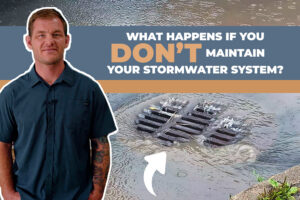
If you’re a property manager or owner, you’ve probably asked yourself: “What is storm water, and how does my property’s system work?” Managing properties, you hear those questions all the time.
That’s why you should check out this latest video, where we break down the essentials while checking out a system on site!
Storm water is any natural precipitation. It includes rain, snow melt, or even condensation running off a roof. We show you how it flows from a paved surface, into a storm drain—which could be a graded inlet or a curb opening—and then down into the underground treatment system.
Every property’s storm water treatment system is a little different, designed to remove things like hydrocarbons and sediments, but the goal is always the same: clean storm water for the environment. You’ll see how we access the underground detention facility for service and inspection, and even how to test for sediment! (Hint: Once you hit 3 inches, maintenance is required).
Plus, we clear up a common confusion: what isn’t storm water? For example, water used in car wash operations is non-storm water and goes to a sewer treatment plant.
If you manage a property in California or Texas and are unsure about your system, this video explains how we can help you get a site map, photos, and a budget quote.
Ready to get the answers? Click play on the video above or contact us today to schedule a consultation. We look forward to hearing from you.
Video Transcript
0:00 Intro
0:19 What is Storm Water and How Does My Storm Water System Work?
0:57 Water Detention Facilities
2:53 What is Storm Water?
3:27 Just Part of the Treatment
0:00 Intro
Hey guys, Joe Warner, president at Texas Compliance Environmental and California Compliance Environmental. We’re here at Tommy’s to look over the storm water system. I managed thousands of properties throughout California and Texas with hundreds of property managers. And one of the common questions I get is what is storm water and how does my storm water system work?
0:19 What is Storm Water and How Does My Storm Water System Work?
So, today we’re going to answer those two questions. So, what is storm water? Storm water is any natural precipitation. It could be snow melt, it could be condensation running off of your roof down the down spouts, or it could just be storm water from the rain event. So, the rain is going to come down from the sky. It’s going to hit your paved surfaces and it’s going to sheet flow into a storm drain. It could be a storm drain like this where it’s a graded inlet or it could be a curb opening that you would find in the gutter line that allows the rain water to fall in. Now that rain water is going to go into that storm drain and it’s going to go down the lateral line into the treatment system.
0:57 Water Detention Facilities
So this is an underground detention facility. So we have a manhole access used for service and inspection. This water is going to flow underground into the treatment chambers and the water is going to settle out. There are many different configurations to storm water filtration systems on site. All trying to achieve different tasks trying to remove sediments, hydrocarbons. Every site’s going to have a different storm water treatment system, but they all result in clean storm water for the environment.
Part of this storm water system, you have a test port. You have the maintenance access and then you also have the test port. We would send our sediment rod down here, test the sediment. Once you get 3 in of sediment in this system, maintenance is required.
So, we have another storm drain here. On properties, you’re going to have different drainage areas designed to capture storm water. So, you’re going to have multiple drains and sometimes multiple vaults to treat that storm water. So, here’s our third drain to cover this drainage area coming down this parking lot. And just beyond this drain, we have a storm sewer manhole. So, this is going to take your treated water from the vault after it’s been infiltrating into the earth and any overflow is going to come into this storm drain manhole and it’s going to shoot straight out to the city where the city or county is going to receive that clean water. So, the treated storm water is going to leave the property now and go to the city or county owned conveyance channels. In this situation, you have an open air conveyance channel. In other situations, you might have it go directly underground to another underground lateral line owned by the city or county.
When Tommy’s was proposing to build this property, they had an empty lot here. And when you have an empty lot, it’s 80% infiltration and only 20% runoff. But since they paved all this surface, now they’re getting 90% runoff and 10% is going to actually infiltrate back into the earth. With this storm water system, they’re actually trying to achieve more infiltration. And when you do invest in a storm water system like that, you have to maintain it.
2:53 What is Storm Water?
When answering the question, what is storm water, I think it’s also important to address what’s not storm water. So all the water from this car wash that’s actually being used in the operations will go through its own separate filtration system, which you can see here in these interceptors. This water is actually going to go to a sewer treatment plant. The same water that goes into the toilets, that’s non storm water, that’s all treated at a facility. Now, all your storm water from the storm drains, those are actually going to your lakes, rivers, creeks, oceans. That’s why it’s important to clean them while they’re on site.
3:27 Just Part of the Treatment
So, we have two trench drains here. This is actually going to go to a sewer treatment plant for treating after it’s been treated here on site. You have the elevations of the concrete here. This is sloped this way to keep this inside where it’s the operations water. And then this is outside; is going to allow the water to drain to the storm drains while trapping the operations water here.
If you’re a property manager or owner and you have questions about your storm water, if you have storm water systems, if you’re unsure, give us a call. In California or Texas, click the link below and we’ll make sure to get you a site map, which is great information. It identifies all your drains and your filtration system, photos of your current conditions, and a budget quote. We look forward to hearing from you and hope you enjoy the day.